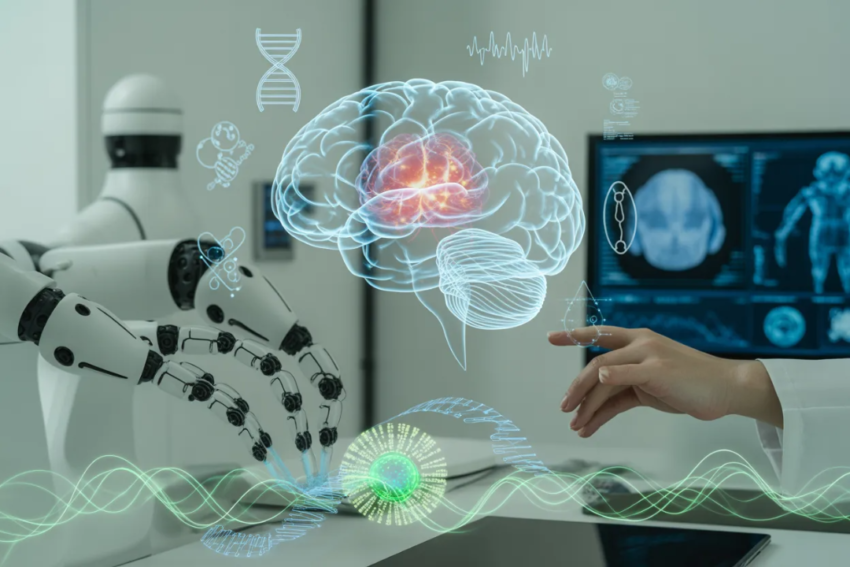
Artificial Intelligence (AI) has moved far beyond experimental research and theoretical applications. In 2026, AI is actively transforming medical science, bridging the gap between research laboratories and real-world clinical practice. What once took years of study, testing, and validation can now be accelerated through AI-driven insights and automation.
From drug discovery in research labs to real-time diagnostics in hospitals, AI is revolutionizing how medical science evolves and how healthcare is delivered. This article explores how AI is reshaping the journey from scientific discovery to patient care, highlighting its impact, benefits, challenges, and future possibilities.
Introduction: The Evolution of Medical Science with AI
Medical science has traditionally progressed through slow, methodical research processes. While this approach ensures safety and accuracy, it often delays the availability of new treatments and technologies.
AI is changing this paradigm by enabling faster data analysis, predictive modeling, and real-time decision-making. Today, AI acts as a bridge that connects laboratory research with clinical implementation, ensuring that scientific breakthroughs reach patients more quickly.
AI in Research Labs: Accelerating Scientific Discovery
AI is revolutionizing research laboratories by enabling scientists to analyze massive datasets and uncover patterns that would be impossible to detect manually.
Key Applications in Research:
1. Drug Discovery and Development
AI algorithms can identify potential drug compounds, predict their effectiveness, and simulate how they interact with the human body.
Impact:
- Reduces drug development timelines
- Cuts research costs
- Increases success rates
AI-driven drug discovery has already led to breakthroughs in areas such as cancer treatment and rare diseases.
2. Genomics and Precision Medicine
AI plays a crucial role in analyzing genetic data, helping researchers understand the relationship between genes and diseases.
Benefits:
- Identification of genetic mutations
- Development of targeted therapies
- Early detection of inherited conditions
This is paving the way for precision medicine, where treatments are tailored to individual patients.
3. Clinical Trial Optimization
AI is improving the efficiency of clinical trials by identifying suitable participants and predicting outcomes.
Advantages:
- Faster recruitment
- Reduced trial failures
- Better data analysis
This ensures that new treatments can be tested and approved more quickly.
Transitioning from Lab to Hospital
One of the most significant impacts of AI is its ability to translate research findings into clinical applications.
How AI Bridges the Gap:
- Converts research data into actionable clinical insights
- Integrates with hospital systems for real-time use
- Enables continuous learning from patient data
AI ensures that innovations developed in labs are not confined to research papers but are implemented in real-world healthcare settings.
AI in Hospitals: Transforming Patient Care
Once confined to research environments, AI is now a critical component of hospital operations and patient care.
1. AI-Powered Diagnostics
Hospitals are using AI tools to analyze medical images, lab results, and patient records.
Benefits:
- Faster and more accurate diagnoses
- Early detection of diseases
- Reduced workload for clinicians
AI is particularly effective in radiology, pathology, and cardiology.
2. Real-Time Clinical Decision Support
AI systems assist doctors by providing evidence-based recommendations during diagnosis and treatment.
Features:
- Instant analysis of patient data
- Risk assessment tools
- Treatment suggestions
This improves decision-making and patient outcomes.
3. Robotic Surgery and Automation
AI-powered robotic systems are enhancing surgical precision.
Advantages:
- Minimally invasive procedures
- Reduced complications
- Faster recovery times
These systems allow surgeons to perform complex operations with greater accuracy.
4. Personalized Patient Care
AI enables hospitals to deliver personalized treatment plans based on individual patient data.
Impact:
- Better treatment outcomes
- Reduced side effects
- Improved patient satisfaction
5. Remote Monitoring and Telemedicine
AI is expanding healthcare beyond hospital walls through remote monitoring and telehealth solutions.
Capabilities:
- Continuous health tracking
- Early alerts for potential issues
- Improved access to care
This is especially beneficial for patients in remote or underserved areas.
Benefits of AI Across Medical Science
AI’s integration from labs to hospitals provides numerous advantages:
1. Faster Innovation
Scientific discoveries are translated into clinical applications more quickly.
2. Improved Accuracy
AI reduces errors in both research and clinical settings.
3. Cost Efficiency
Automation and optimization lower healthcare and research costs.
4. Enhanced Collaboration
AI facilitates collaboration between researchers, clinicians, and institutions.
5. Better Patient Outcomes
Early detection and personalized treatments lead to improved health outcomes.
Challenges in Integrating AI
Despite its transformative potential, AI faces several challenges in medical science:
1. Data Integration Issues
Combining data from research labs and hospitals can be complex.
2. Ethical Concerns
Issues such as data privacy and informed consent must be addressed.
3. Regulatory Barriers
AI technologies must meet strict regulatory standards before clinical use.
4. High Costs
Implementing AI systems requires significant investment.
5. Resistance to Change
Healthcare professionals may be hesitant to adopt new technologies.
The Future of AI in Medical Science
The future of AI in healthcare is promising, with innovations expected to further bridge the gap between research and clinical practice.
Emerging Trends:
1. AI-Driven Smart Hospitals
Fully integrated systems will manage patient care, diagnostics, and operations.
2. Advanced Predictive Modeling
AI will predict disease outbreaks and individual health risks with greater accuracy.
3. Integration with Emerging Technologies
AI will work alongside technologies like blockchain, IoT, and advanced robotics.
4. Continuous Learning Systems
AI models will improve over time by learning from new data and outcomes.
5. Global Collaboration
AI will enable researchers and healthcare providers worldwide to share data and insights.
SEO Keywords Included
AI in medical science, AI in healthcare 2026, artificial intelligence in medicine, AI drug discovery, AI diagnostics, AI hospitals, healthcare innovation, future of AI in healthcare, AI research labs, AI patient care.
Conclusion
Artificial Intelligence is transforming medical science by bridging the gap between research laboratories and hospitals. It is accelerating scientific discovery, improving diagnostics, and enabling personalized patient care.
As AI continues to evolve, its integration into healthcare will deepen, leading to faster innovations and better outcomes. While challenges such as data privacy, cost, and regulation remain, the potential of AI to revolutionize medical science is undeniable.
The journey from lab research to patient care is becoming faster, smarter, and more efficient—thanks to AI. The future of healthcare lies in this powerful synergy between technology and human expertise.